
Heart Disease: Tests to Diagnose Heart Disease
________________________________________________________________________
KEY POINTS
- Many tests can help to diagnose heart disease. Which tests you have depends on your symptoms, risk factors, and history of heart problems.
- Talk to your healthcare provider about what the test results mean and ask any questions you have.
________________________________________________________________________
Many tests can help to diagnose heart disease. Which tests you have depends on your symptoms, risk factors, and history of heart problems.
Coronary angiogram
An angiogram is a series of X-rays taken after your healthcare provider injects a special dye into your blood vessels to look for narrowing, weakness, or blockages in blood vessels. A coronary angiogram looks at the blood vessels that carry blood to your heart muscle. This helps your provider check for problems that increase your risk for a heart attack.
Chest X-ray
An X-ray is the use of energy called radiation to make pictures of the inside of your body. As the X-rays pass through your body, different tissues absorb different amounts of radiation and show up in different shades of black and white on film or a computer screen. A chest X-ray can show:
- If the heart is enlarged or normal
- Fluid in the lungs
CT Angiogram
A CT angiogram, also called computed tomography angiogram, is a special type of X-ray test. X-rays are taken from different angles after dye is injected into a vein, and a computer puts the X-ray pictures together to create detailed views of the heart.
This scan may be done to:
- Look for narrowing, weakness, or blockages in blood vessels.
- See how well your heart is working.
- Check the heart valves.
- Look at structures around the heart, such as the pericardium (the thin membrane around the heart) and the aorta (the large blood vessel that carries blood to your body).
Ultrafast CT scan
An ultrafast CT scan, also called computed tomography or CAT scan, is a special type of X-ray test for the heart. X-rays are taken from different angles and a computer puts the X-ray pictures together to create detailed views of the blood vessels that bring blood and oxygen to the heart muscle. It is called ultrafast because hundreds of pictures can be taken during each heartbeat.
This scan is done to check for calcium buildup in the blood vessels that bring blood and oxygen to the heart muscle. Normal coronary arteries have very little or no calcium in them. This scan may predict a heart attack in someone who appears healthy.
Echocardiogram
An echocardiogram is a test that uses sound waves (ultrasound) and a computer to look at your beating heart. This test is used to check the size, thickness, and movement of your heart, and how well it pumps.
Electrocardiogram
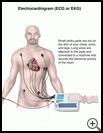
An electrocardiogram (ECG or EKG) is a test that shows the electrical activity of the heart.
An ECG, often done along with other tests, can show:
- How fast the heart is beating
- Abnormal heartbeats and heart rhythms
- Heart muscle damage from heart disease
- Heart problems you were born with, such as abnormal heart valves or holes in the heart
Exercise stress test
An exercise stress test is done to examine your heart as you exercise. While you exercise on a treadmill or pedal a stationary bicycle, an ECG (also called an EKG or electrocardiogram) measures and records your heartbeat. Your blood pressure readings are also recorded while you exercise.
You may have an exercise test to check for narrowing in blood vessels that carry blood, oxygen, and nutrients to your heart. Narrowing of these blood vessels may not cause symptoms when you are resting. During exercise your heart works harder and needs more blood. Recording the ECG before, during, and after exercise can show if parts of your heart are not getting enough blood.
This test may also be done to see how well treatment for heart disease is working, or to help develop a safe exercise program for you.
Holter monitor
A Holter monitor is a small device that records the electrical activity of your heart for 24 hours to a week at a time. The monitor is about the size of a deck of cards, and you wear it during your normal daily activities, including sleeping. Holter monitors are a way to find heart rhythm problems that may happen only occasionally.
Magnetic resonance imaging (MRI)
An MRI uses a strong magnetic field and radio waves to show detailed pictures of the structure and function of the heart.
If you have a pacemaker, implantable cardiac defibrillator (ICD), or other metal in your body, you may not be able to have an MRI.
Magnetic resonance angiography (MRA)
An MRA uses a strong magnetic field and radio waves to show detailed pictures of the body’s blood vessels.
Multigated graft acquisition (MUGA) scan
A MUGA scan uses a radioactive chemical injected into your vein to show how well your heart is pumping. It measures the amount of blood that is pumped with each heartbeat, and the flow of blood into the pumping chamber. A MUGA scan also gives information about the size of the pumping chambers of the heart and the strength of the heart muscle. This test is also called a radionuclide ventriculogram (RVG) or a gated blood pool scan.
Positron emission tomography (PET) scan
A PET scan is a series of detailed pictures of your body that are taken after your healthcare provider injects a small amount of radioactive material into your blood. It may be done to find:
- Early coronary artery disease
- Damaged or scarred heart muscle
Radioisotope stress test
This test may be done along with an exercise stress test on a treadmill or bicycle. A radioactive chemical called a radionuclide, or tracer, may be injected into a vein in your arm at the peak of exercise. The tracer can show the blood flow in the heart.
What if my test result is not normal?
Test results are only one part of a larger picture that takes into account your medical history and current health. Sometimes a test needs to be repeated to check the first result. Talk to your healthcare provider about your result and ask questions, such as:
- If you need more tests
- What kind of treatment you might need
- What lifestyle, diet, or other changes you might need to make
